

Jackie’s Take: What’s On My Mind in Women’s Wellness✍️
I posted a reel a few weeks ago about what I would do if I found out I had an elevated Lp(a). Five things. Practical, evidence-based, nothing revolutionary if you've been following me for a while. I expected the usual engagement: some saves, a few DMs, maybe a handful of questions about testing.
What I got was a war zone in the comments.
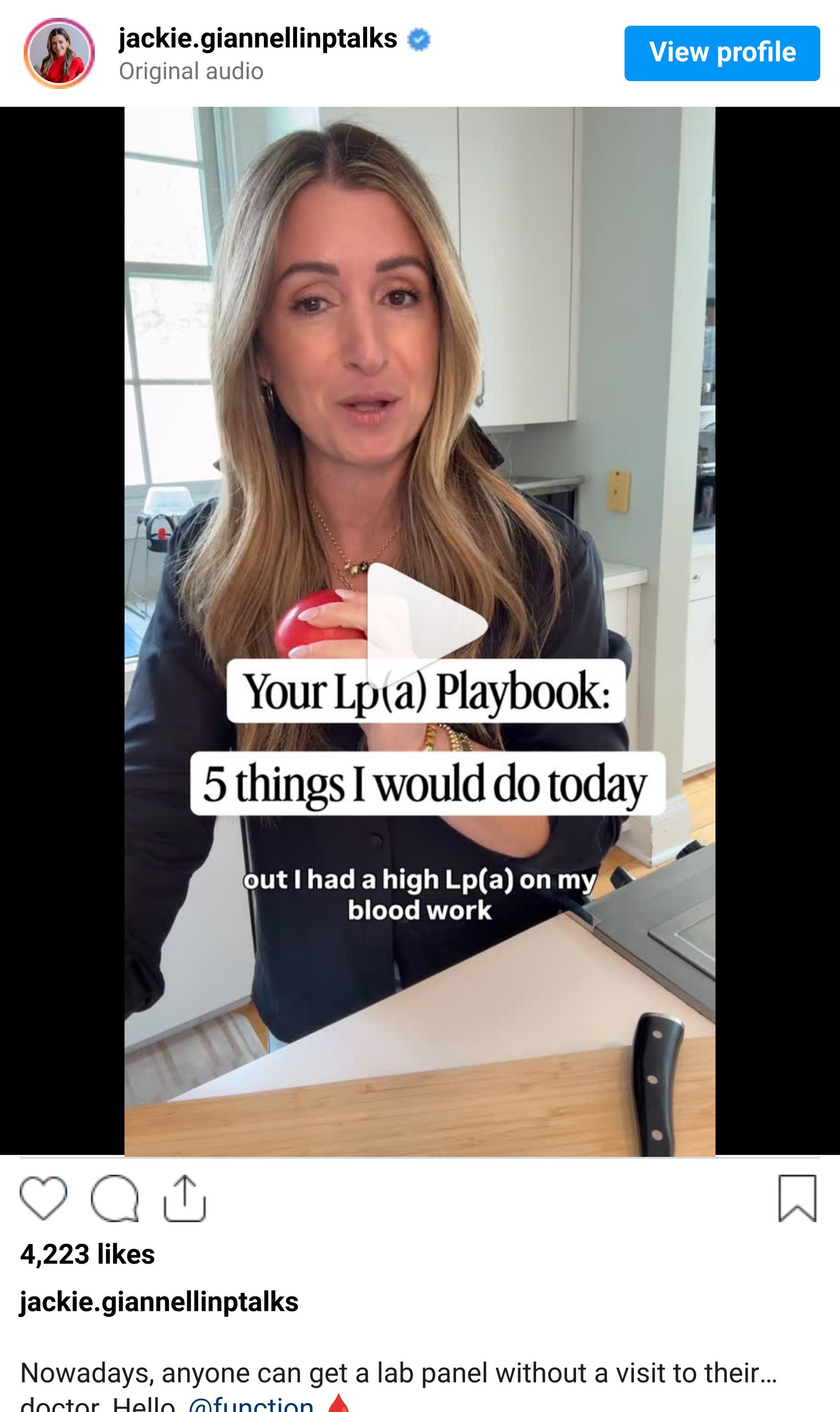
The comments took on a life of their own, and not because people loved the content (though some did). All because I (briefly) said the word statin. After that, it was the only thing anyone wanted to talk about.
"NEVER use a statin." "Toxic." "Statins made my doctor rich and made me sick." "Why are you pushing Big Pharma?" Some of these comments had paragraphs. Citations. Passion that I recognized, because I hear it in my consult room every single week.
So I did something I don't usually do. I went back in. I sat with the comments, all of them, and I pulled the top objections. Not to argue. Not to defend. To actually look at the evidence behind what my audience was saying, because here's what I know after over a decade of practice: when smart women push back this hard, there is almost always a reason that deserves to be taken seriously.
This is what I found.
Objection #1: "Statins raise Lp(a). You're making the problem worse."
This one came in hot. Multiple commenters, some citing specific studies, some clearly clinicians themselves.
And they're right.
A 2020 meta-analysis showed that statins increase Lp(a) levels by roughly 10 to 20 percent. This is not wellness-internet hysteria. The mechanism appears to involve statin-induced upregulation of apo(a) synthesis, which is a fancy way of saying the drug nudges your liver to produce more of the thing you're trying to lower.
The reason we prescribe statins in a patient with elevated Lp(a) was never to lower the Lp(a). We prescribe them to lower the total ApoB burden. Think of it this way: if your house is flooding from two different pipes, you shut off the one with the bigger leak first. The water level still drops, even if the other pipe is still running. A 2018 Lancet meta-analysis confirmed that patients with high Lp(a) on statin therapy still carry elevated risk, yes, but the overall atherosclerotic burden is reduced because the LDL-C piece is being managed aggressively.
And there's a piece of this that doesn't get talked about enough: in patients with a positive coronary artery calcium scan (meaning actual plaque burden, both soft and calcified), driving LDL below 70 doesn't just prevent new events. We see regression of soft plaque. Statins can literally help melt plaque away.
Patients are reading the literature correctly. The clinical pivot is making sure they understand why the statin is still in the conversation, not as a treatment for Lp(a), but as protection for everything around it.
Objection #2: "Statins destroyed my muscles. They're toxic to women."
This one I hear in clinic constantly. And the data backs the frustration up in a way that should make all of us uncomfortable.
Women are significantly more likely to discontinue statins due to muscle symptoms than men. A study in the Journal of Clinical Lipidology documented this sex disparity clearly: women report more side effects, more impact on daily life, and more dissatisfaction with statin therapy. A separate prospective study found the same pattern. And the uncomfortable historical context is that women were dramatically underrepresented in the foundational statin trials, with female enrollment ranging from 14 to 69 percent, often without sex-stratified analysis.
So when a woman tells me she tried a statin and couldn’t tolerate it, I believe her. Not because I'm being polite. Because the pharmacokinetic and pharmacodynamic differences between male and female bodies are real, and we built the safety profile of these drugs on trials that didn't adequately include the population sitting in front of me.
That said, believing someone's experience doesn't mean the only option is to walk away from the drug class entirely. It means we try a different statin, a lower dose, an alternate-day protocol, or we add CoQ10 and recheck. It means we take her seriously enough to problem-solve instead of just prescribing or just quitting.
Objection #3: "Statins cause diabetes. You're trading one disease for another."
A 2024 analysis in The Lancet Diabetes & Endocrinology confirmed what many clinicians have quietly known: statins cause a moderate, dose-dependent increase in new type 2 diabetes diagnoses. The mechanism involves a small upward shift in insulin resistance, and the risk is highest among patients who already have prediabetes or metabolic syndrome components.
For women in perimenopause and menopause, this is where it gets complicated. Estradiol is profoundly insulin-sensitizing. When it declines, insulin resistance rises. Layering a diabetogenic medication on top of an already shifting metabolic landscape requires a conversation that most ten-minute cardiology appointments do not have time for.
The metabolic cost of statins is real. The question is whether the cardiovascular benefit outweighs that cost for this specific patient, and that calculation requires looking at her hormones, fasting insulin, her inflammatory markers, her family history, and frankly, her lifestyle. Not just her LDL.
Objection #4: "I'll just take niacin and bergamot. Problem solved."
Several commenters were passionate about this. One cited a 63 to 75 percent decrease in Lp(a) from niacin. Others swore by citrus bergamot for lipid management.
The niacin piece is partially true. Extended-release niacin can lower Lp(a) by 20 to 30 percent (the 63 to 75 percent claim is an extreme outlier). But the large randomized trials, AIM-HIGH and HPS2-THRIVE, showed something deeply frustrating: niacin improved the lipid numbers without reducing the actual cardiovascular events. The lab results looked better. People still had heart attacks at the same rate. And niacin increased the risk of new-onset diabetes.
Bergamot is gentler on paper. Clinical trials show modest reductions in total cholesterol and LDL-C, but with far weaker potency than statins. For someone with mild dyslipidemia or genuine statin intolerance, it might be a reasonable piece of the puzzle. For someone with an Lp(a) of 393 and a history of bypass surgery (a real comment from my reel), it is not going to be enough.
This is the distinction my commenters were missing, and it matters: lowering the number on the lab report is not the same as preventing the cardiac event. Surrogate markers and hard outcomes are not interchangeable, no matter how badly we want them to be.
Objection #5: "My doctor just threw Crestor at me and never mentioned anything else."
One commenter wrote that she had an Lp(a) of 393, had already had bypass surgery and a heart attack, and her doctor had never mentioned anything beyond Crestor. She said she thought she needed a new doctor.
She might be right.
This is the objection that I can't argue with, because it reflects a real failure in how cardiovascular care is delivered.
Patients are turning to Facebook groups and Instagram comment sections because, on some level, they have lost trust in the version of medicine they've been offered. And that version, for many women, wasn't built to hold the full complexity of what's actually happening in their bodies.

Dr. Doug Ross nods in agreement
Where I Land
Menopause is the single largest inflection point for cardiometabolic risk in a woman's life. Full stop. Estradiol drops, and with it goes vascular protection, insulin sensitivity, favorable lipid metabolism, and on from there. The cardiovascular playing field that was already tilted against us becomes something closer to a cliff.
And the women showing up in my comments? They are paying closer attention to their cardiovascular health than any generation of women before them. They are ordering their own advanced lipid panels. They are reading the primary literature. They are asking about Lp(a) before their cardiologists bring it up. They are doing the work.
The resistance to statins that I saw in those comments is not anti-science. It is, in many cases, a response to a medical system that historically prescribed first and listened second, that handed women the same drug at the same dose that was studied primarily in men, and then dismissed them when they reported side effects that the trials hadn't bothered to segment for.
Statin hesitancy in women is not a knowledge problem. It is a trust problem. And trust is rebuilt through conversations like this one, where the evidence gets laid out honestly, where the valid concerns are separated from the misinformation, and where a woman's cardiometabolic health during and after menopause is treated as the differentiated variable it actually is.
I don't want my patients to refuse statins reflexively. I also don't want them to accept statins passively. I want them walking into that appointment with their full picture: their ApoB, their Lp(a), their fasting insulin, their inflammatory markers, their hormonal status, their lived experience. I want the conversation to be long enough to hold all of it.
Women are taking their cardiovascular health seriously. The question that remains is whether the medical institution will meet them there.
Hit reply. Tell me what you're seeing. I read every one.
Worth the Click 🔗
Big news out of Cleveland Clinic this week, heading into ASCO next week for presentation. Researchers looked at over 10,000 cancer patients and found that those who started a GLP-1 drug after their diagnosis were significantly less likely to progress to stage 4.
The standout numbers: a 43% reduction in breast cancer progression and a 50% reduction in lung cancer progression compared to patients on a different diabetes drug. Researchers believe the GLP-1 receptors on tumor cells themselves may be part of the mechanism, potentially cutting off the tumor's energy supply and boosting immune response.
The caveat: this is an observational study, not a randomized clinical trial, so it cannot prove cause and effect. But for women in midlife who are already navigating GLP-1 conversations for metabolic health, this is a data point worth watching closely. Read the full breakdown here.

Lung cancer seen on an MRI scan. Cavallini James / Getty
The Find 🛍️
This little pillow has earned a special spot on my bed. And here’s why ⤵

The Prim by Tabu is a memory foam pillow designed for partners that elevates the pelvis during intimacy, which translates to less lower back and hip pain and more satisfaction for both of you. It's covered in washable linen, it looks like it belongs in your stack, and I promise your husband (or partner) will never complain about too many decorative pillows again. 🛏️

The Prim
Saddle Up & Spread the Word 🏇💨

If this made you think differently about sleep, send it to your most well-read, wellness-obsessed, or wildly curious friend. Or that one person in your group chat who takes 10mg of melatonin every night and swears it’s fine. Sharing is caring, and also excellent for karma. 💌
To share — Just click and copy this link: https://inthesaddle.beehiiv.com/
If you’re a brand, expert, or just someone with an excellent story to tell in the wellness, longevity, or sexual health space, I’d love to connect! I am always open to hearing ideas for ITS content and collabs. ✏️ 🏇🔥
With gratitude always,
Jackie Giannelli, FNP-BC, MSCP
Founder, In the Saddle
Medical Disclaimer:
The content provided in this newsletter is for informational and educational purposes only and is not intended as a substitute for professional medical advice, diagnosis, or treatment. Nothing contained herein should be construed as medical guidance or the practice of medicine. You should always seek the advice of your physician or other qualified healthcare provider with any questions you may have regarding a medical condition or treatment. Never disregard professional medical advice or delay seeking care because of something you read in this newsletter. Use of the information provided is at your own risk. No clinician-patient relationship is formed through this content.
*This newsletter may contain affiliate links. If you choose to purchase through these links, I may earn a small commission at no additional cost to you. All recommendations are my own, and I only share products I personally use or trust.